
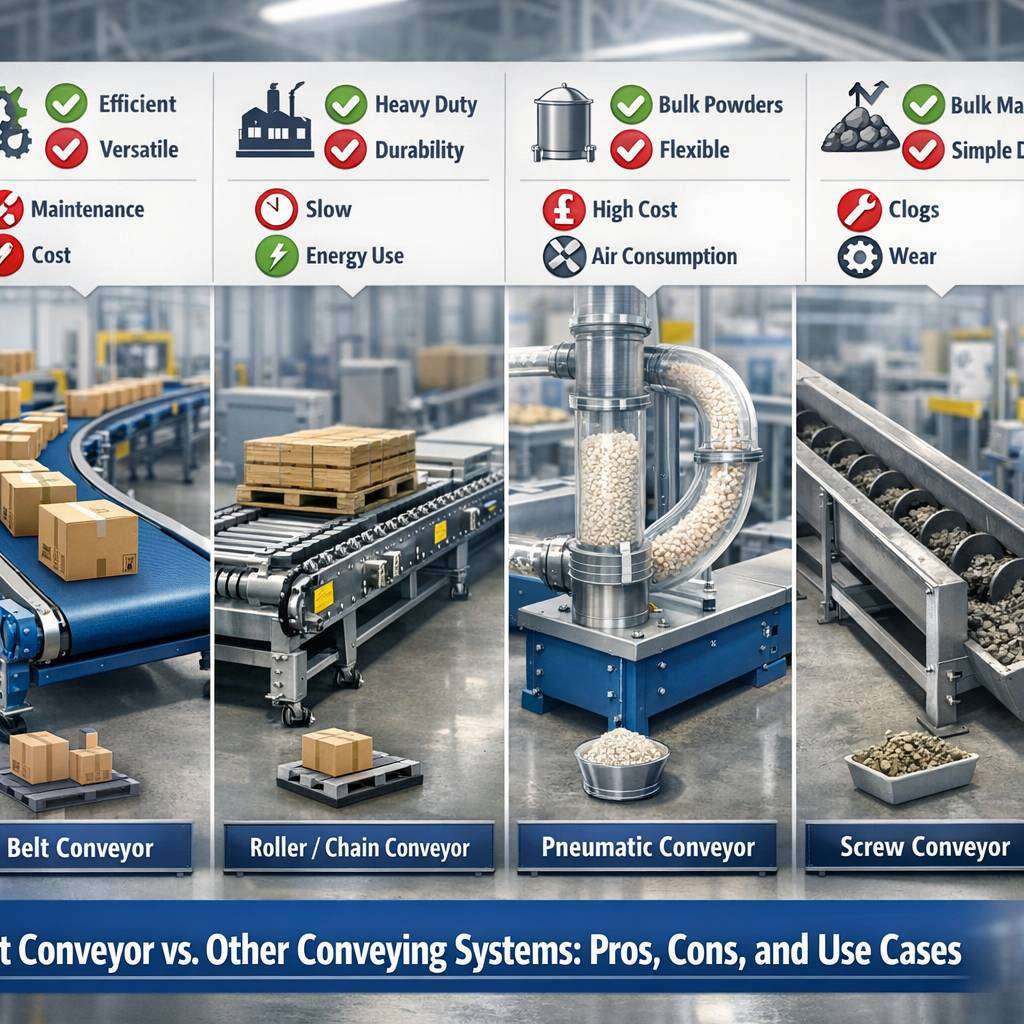
Belt conveyors are a familiar sight in many industrial settings, moving goods smoothly along a dedicated path. Their simplicity, reliability, and scalability have kept them popular for decades, and they continue to evolve with new materials and designs. In this article, we explore how belt conveyors compare with other conveying systems, highlighting the advantages and limitations you might encounter in real-world applications.
In addition to the traditional roller belt conveyor and flat belt conveyor formats, there are many variants—such as heavy duty belt conveyors, inclined belt conveyors, modular belt conveyors, and specialised systems—that can be tailored to specific tasks. By understanding the pros, cons, and typical use cases of each option, you can make a more informed choice for your operation and partner with a trusted belt conveyor manufacturer to source the right equipment.
Belt conveyors come in a broad spectrum of configurations, from compact, lightweight models designed for small parts to robust, heavy-duty systems handling palletised loads. The right selection depends on load characteristics, space constraints, speed requirements, maintenance considerations, and total cost of ownership. Below, we compare belt conveyors with common alternatives and outline scenarios where each excels.
What is a belt conveyor?
A belt conveyor uses a continuous loop of belt material driven by pulleys and rollers to move goods along a conveying line. Variants include roller belt conveyors, flat belt conveyors, modular belt conveyors, and inclined belt conveyors. A typical system integrates drive units, take-up devices, and control technologies to maintain tension, speed, and alignment.
Pros of belt conveyors
- Reliability and simplicity: Fewer moving parts than some alternatives reduce maintenance needs and downtime.
- Wide range of capacities: From light duties to heavy duty belt conveyors can be designed to handle varied loads.
- Energy efficiency: Properly sized belts and rollers optimise power use, especially with low-friction or premium belt materials.
- Gentle handling options: For delicate products, flat belt or modular belt conveyors offer smooth contact and reduced damage.
- Flexibility in layout: Straight runs, gentle inclines, or spiral configurations can suit constrained spaces.
- Availability of accessories: Drip pans, guards, lifting sections, and integrated sensors are commonly available through many conveyor system providers.
Cons of belt conveyors
- Limited height changes: Steep inclines and declines can require additional components or alternative systems.
- Handling irregular shapes: Non-uniform or very small parts may require special belt textures or gripper solutions.
- Maintenance on tensioned belts: Tensioning and tracking maintenance are necessary to prevent belt wandering.
- Noise and vibration: Some configurations can generate more noise, particularly in heavy duty applications or when misaligned.
- Upfront cost for large or complex systems: While cost-effective over time, initial investment can be significant for extensive layouts.
A belt conveyor streamlines material handling, improving efficiency and throughput across industrial settings. For reliable solutions, visit https://power-packconveyor.com/ and explore durable, customized belt conveyor systems designed to fit your production line needs. Optimal performance, minimal downtime, and scalable options await your facility’s upgrade.
Common belt conveyor types and their use cases
- Roller belt conveyor: Combines roller support with belt traction, great for medium to heavy loads and conveyors with curves or transfers. Suitable where load is stable and requires moderate grip.
- Flat belt conveyor: A versatile, generic option ideal for diverse products and straightforward layouts. Great for unit loads, boxes, pouches, and components with flat bottoms.
- Industrial belt conveyor: Broad category encompassing many heavy, durable designs used in manufacturing, mining, and packaging. Choose for high reliability and long service life.
- Heavy duty belt conveyor: Built to move large, dense, or abrasive materials with robust frames, high-tension belts, and reinforced components. Common in mining, timber, and steel operations.
- Modular belt conveyor: Uses interlocking belt modules to enable easy cleaning, drainage, and product handling flexibility. Excellent for wet or oily environments and for sanitation-sensitive processes.
- Inclined belt conveyor: Designed to move products between elevations efficiently. Often paired with decline sections, cleats, or chevron belts to prevent rolling or slippage.
- Belt conveyor manufacturer: A partner who can design, fabricate, and install tailored systems, from standard platforms to custom, high-automation lines.
A belt conveyor is essential for efficient material handling in modern warehouses, manufacturing facilities, and mining operations. Its continuous, smooth operation reduces manual labor, speeds up production, and improves safety by transporting bulky goods along a controlled path. For reliable components and expert solutions, explore updated designs and support. In this context, valuable resources can be found at https://conveyorrollers.co.uk.
Belt conveyor systems improve efficiency in material handling, reducing manual labor and boosting throughput. This guide explores maintenance tips, safety considerations, and best practices for setup and operation. For in-depth learning, visit the resource: https://learn.mines.edu/conveyor/ to enhance your understanding of belt conveyor applications.
A belt conveyor is a reliable, cost-efficient solution for moving materials across long distances with minimal manual handling. It reduces labor and enhances throughput, making plants safer and more productive. For advanced options, consider durable components and maintenance tips. https://www.rexnord.com/products-services/process-motion-control/conveying-solutions/kleantop-conveyor-belts
How belt conveyors compare with other conveying systems
- Pneumatic conveyors: Move bulk materials through air pressure or vacuum. Pros include continuous flow, no mechanical transfer points, and suitability for fragile powders. Cons include dust generation, higher energy usage, and less suitability for large solid objects.
- Chain conveyors: Provide robust handling for heavy, bulky items and can pull heavy loads at low speeds. They are typically more durable for severe environments but require more maintenance and can be less gentle on products.
- Screw conveyors: Excellent for bulk powders and granular materials in enclosed spaces. They are compact and dust-tight but not ideal for discrete items or delicate goods.
- Gravity conveyors: Simple, passive systems that rely on gravity or ramps. They are cost-effective for straightforward lines but cannot control speed or handle uphill sections efficiently.
- Roller conveyors: A subset of belt conveyors that utilise rollers with or without belts. They excel in accumulating or supporting heavy loads in long, straight lines.
- Vacuum conveyors: Move materials via suction for fines and powders. They require sealed environments and careful dust management, but offer clean and contained transfer.
Use-case guidance: when to choose a belt conveyor
- Product integrity is critical: For delicate items or finish-sensitive components, a flat belt or modular belt conveyor can offer smooth, controlled handling.
- Complex routing with transfer points: Roller belt conveyors fertilise flexible layouts with curved paths and multiple transfer stations.
- Cleanliness and washdown: Modular belt conveyors and certain heavy duty belt conveyors are designed for easy cleaning and high sanitation standards.
- Elevation changes: Inclined belt conveyors are well-suited to bridging height gaps, especially when combined with cleats or textured belts to prevent backward slip.
- High-load conditions: For palletised goods or heavy machinery components, a robust industrial belt conveyor or heavy duty belt conveyor is ideal.
Selection considerations
- Load type and size: Avoid under- or over-sizing; consult a belt conveyor manufacturer for calculations on belt width, tension, and drive power.
- Environment: Temperature, humidity, dust, and washdown requirements influence belt material choice and frame protection.
- Space and routing: Plan routes for straight runs, turns, and elevation changes; modular belts can simplify complicated layouts.
- Maintenance strategy: Consider ease of replacement, availability of spare parts, and compatibility with automated controls.
- Total cost of ownership: Include energy, maintenance, downtime, and potential throughput improvements when evaluating options.
In summary, belt conveyors remain a versatile backbone of many material handling systems, with endless variants to match specific product handling needs. Whether you opt for a roller belt conveyor, a modular belt conveyor, or an inclined belt conveyor, partnering with a reliable belt conveyor manufacturer will help you translate requirements into a robust, efficient solution.